

Order Without Power
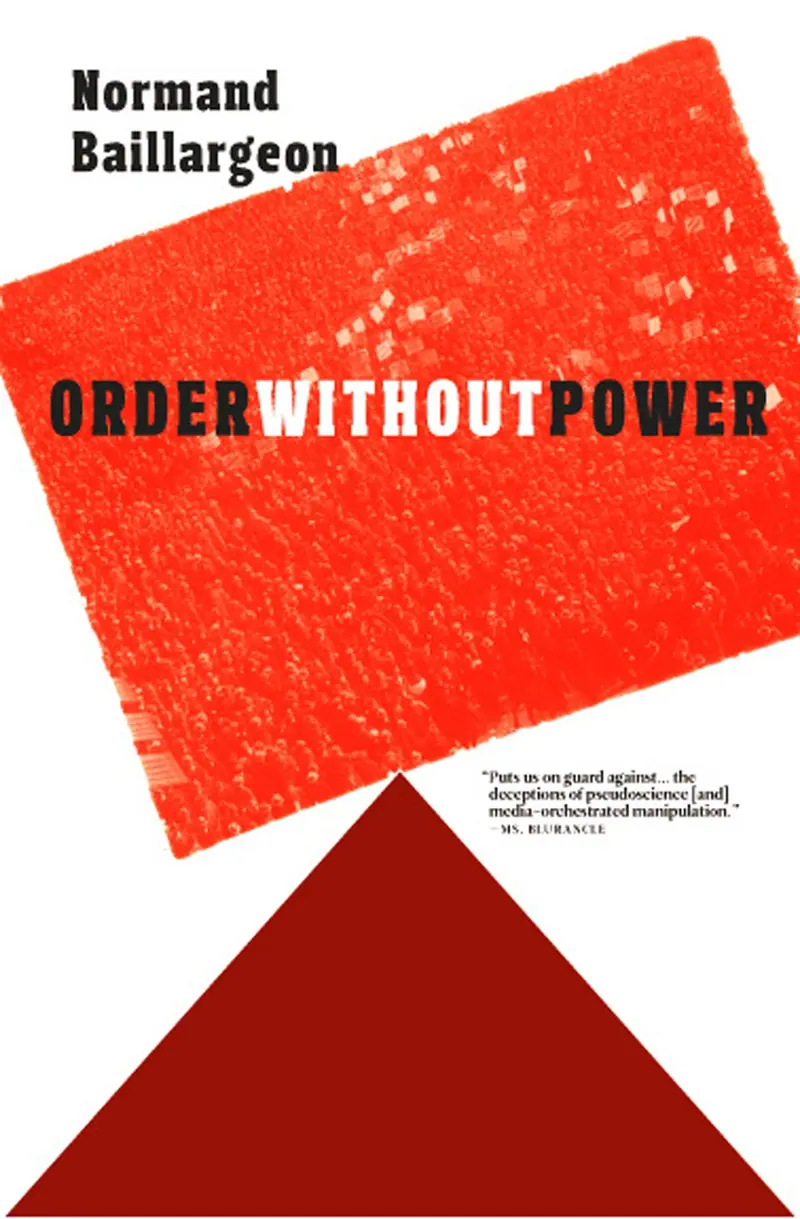
cover
Wish list
Share
Share this book
Readership
Order Without Power
In this lively primer to anarchism, scholar and author Normand Baillargeon explains the vibrant heart of anti-authoritarianism, or the rational and conscious refusal of any form of illegitimate authority and power. Translated by Mary Foster With the rise of the global protestor-from Arab Spring to…
Buy now $32.99
readership.com.au/book/order-without-power
Order Without Power
An Introduction to Anarchism: History and Current Challenges
About this book
In this lively primer to anarchism, scholar and author Normand Baillargeon explains the vibrant heart of anti-authoritarianism, or the rational and conscious refusal of any form of illegitimate authority and power.
Translated by Mary Foster
With the rise of the global protestor-from Arab Spring to the Occupy movement-the term "anarchist" has been littered throughout mainstream media as never before. But just as frequently, its definition is skewed or left wanting: anarchists are painted as nihilists, supporters of chaos, or even terrorists.
In Order without Power, an informative primer, Normand Baillargeon thoroughly defines anarchism and recounts its long history. In outlining the forerunners of this movement, he illuminates the differences between collectivists, federalists, communists, syndicalists, and further strains such as anarcho-feminism, pacifist anarchism, and religious anarchism. With sharp examples and concise, lively language, Baillargeon describes the contributions from early anarchists like William Godwin, Max Stirner, Pierre Joseph Proudhon, Mikhail Bakunin, and Pierre Kropotkin, through Noam Chomsky, as well as the uprisings, struggles, revolts, and revolutions that tested or expanded the theories. From the International Workingmen's Association to Haymarket, from the Russian Revolution to May 1968, Baillargeon unpacks anarchism's position on various issues and reveals this political theory's vibrant heart: anti authoritarianism, or the rational and conscious refusal of any form of illegitimate authority and power.
Product details
ISBN
9781609804718
Published
15 October 2013
Format
Paperback
Pages
224
Dimensions
209 × 139 × 11 mm
Weight
0.16 kg
Publisher
RANDOM HOUSE US
Imprint
SEVEN STORIES PRESS
Audience
General Adult
Topics
Best sellers in Political Ideologies
You might also like

$14.99

$48.44
$56.99
15% OFF
$33.99
$39.99
15% OFF

$29.74
$34.99
15% OFF



Link copied