

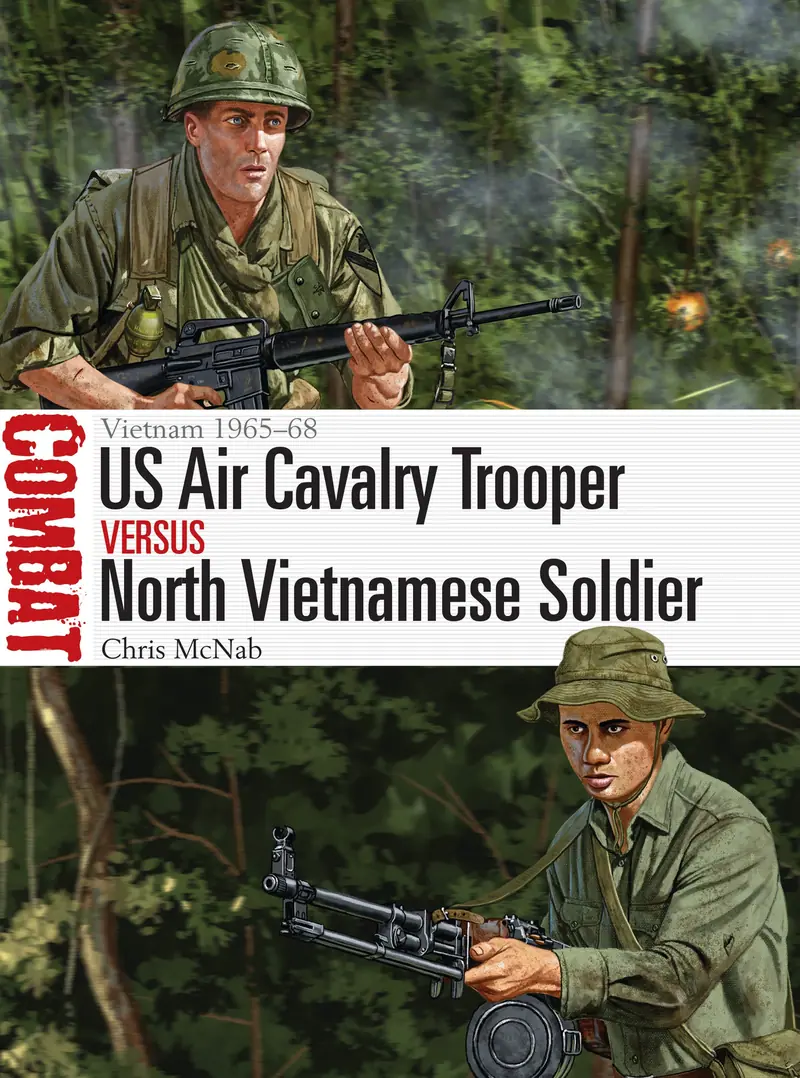
US Air Cavalry Trooper vs North Vietnamese Soldier: Vietnam 1965-68
cover
Wish list
Share
Share this book
Readership
US Air Cavalry Trooper vs North Vietnamese Soldier: Vietnam 1965-68
The tactics and technologies of modern air assault vertical deployment of troops by helicopter or similar means emerged properly during the 1950s in Korea and Algeria. Yet it was during the Vietnam War that helicopter air assault truly came of age and by 1965 the United States had established fully…
Buy now $39.99
readership.com.au/book/us-air-cavalry-trooper-vs-north-vietnamese-soldier-vietnam-1965-68
US Air Cavalry Trooper vs North Vietnamese Soldier: Vietnam 1965-68
About this book
The tactics and technologies of modern air assault vertical deployment of troops by helicopter or similar means emerged properly during the 1950s in Korea and Algeria.
Yet it was during the Vietnam War that helicopter air assault truly came of age and by 1965 the United States had established fully airmobile battalions, brigades, and divisions, including the 1st Cavalry Division (Airmobile).This division brought to Vietnam a revolutionary new speed and dexterity in battlefield tactics, using massed helicopters to liberate its soldiers from traditional overland methods of combat manoeuvre.
However, the communist troops adjusted their own thinking to handle airmobile assaults. Specializing in ambush, harassment, infiltration attacks, and small-scale attrition, the North Vietnamese operated with light logistics and a deep familiarity with the terrain. They optimized their defensive tactics to make landing zones as hostile as possible for assaulting US troops, and from 1966 worked to draw them into 'Hill Traps', extensive kill zones specially prepared for defencee--ine--depth. By the time the 1st Cavalry Division (Airmobile) withdrew from Vietnam in 1972, it had suffered more casualties than any other US Army division.
Featuring specially commissioned artwork, archive photographs, and full-colour battle maps, this study charts the evolution of US airmobile tactics pitted against North Vietnamese countermeasures. The two sides are analysed in detail, including training, logistics, weaponry, and organization.
Product details
ISBN
9781472841759
Published
3 November 2020
Format
Paperback
Pages
80
Dimensions
245 × 184 × 5 mm
Weight
0.266 kg
Publisher
Bloomsbury
Imprint
Osprey
Audience
General Adult
Listed in
Topics
Best sellers in Military History
You might also like








Link copied