

Maurice Blanchot and Fragmentary Wr: A Change of Epoch
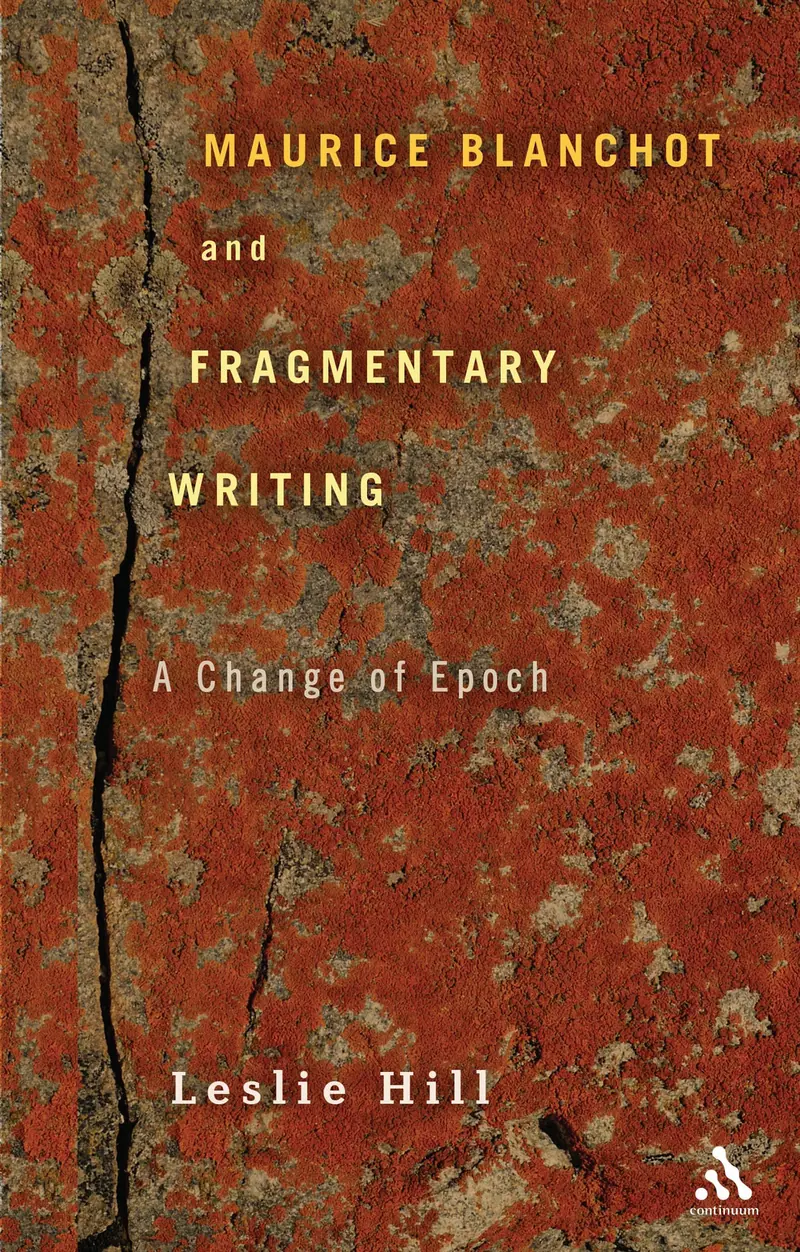
cover
Wish list
Share
Share this book
Readership
Maurice Blanchot and Fragmentary Wr: A Change of Epoch
Writing in fragments is often held to be one of the most distinctive signature effects of Romantic, modern, and postmodern literature. But what is the fragment, and what may be said to be its literary, philosophical, and political significance? Few writers have explored these questions with such…
Buy now $86.99
readership.com.au/book/maurice-blanchot-and-fragmentary-wr-a-change-of-epoch
Maurice Blanchot and Fragmentary Wr: A Change of Epoch
A Change of Epoch
About this book
Writing in fragments is often held to be one of the most distinctive signature effects of Romantic, modern, and postmodern literature. But what is the fragment, and what may be said to be its literary, philosophical, and political significance? Few writers have explored these questions with such probing radicality and rigorous tenacity as the French writer and thinker Maurice Blanchot.
For the first time in any language, this book explores in detail Blanchot's own writing in fragments in order to understand the stakes of the fragmentary within philosophical and literary modernity. It attends in detail to each of Blanchot's fragmentary works (Awaiting Forgetting, The Step Not Beyond, and The Writing of the Disaster) and reconstructs Blanchot's radical critical engagement with the philosophical and literary tradition, in particular with Hegel, Nietzsche, Heidegger, Heraclitus, Levinas, Derrida, Nancy, Mallarme, Char, and others, and assesses Blanchot's account of politics, Jewish thought, and the Shoah, with a view to understanding the stakes of fragmentary writing in Blanchot and within philosophical and literary modernity in general.
Product details
ISBN
9781441166227
Published
6 September 2012
Format
Paperback
Pages
400
Dimensions
216 × 141 × 29 mm
Weight
0.596 kg
Publisher
Bloomsbury
Imprint
Bloomsbury Academic
Audience
General Adult
Best sellers in Literary Theory
You might also like

$19.99

$19.99





$19.99




Link copied